what does it mean to be least in the kingdom of heaven
| Matthew 5:19 | |
|---|---|
| ← 5:18 five:twenty → | |
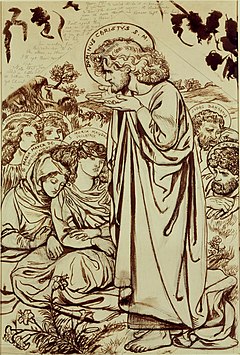 "The Sermon on the Mount" (c. 1861), by Dante Gabriel Rossetti (1828–1882). | |
| Book | Gospel of Matthew |
| Christian Bible part | New Testament |
Matthew 5:19 is the nineteenth poesy of the fifth affiliate of the Gospel of Matthew in the New Attestation and is part of the Sermon on the Mountain. Jesus has reported that he came not to destroy the law, just fulfil it. In this poesy he perhaps continues to reinforce this claim.
Content [edit]
in the King James Version of the Bible the text reads:
- Whosoever therefore shall intermission one of these least
- commandments, and shall teach men so, he shall exist
- called the least in the kingdom of heaven: but
- whosoever shall practise and teach them, the aforementioned
- shall be called bully in the kingdom of heaven.
The World English Bible translates the passage as:
- Whoever, therefore, shall interruption ane of these
- to the lowest degree commandments, and teach others to do so,
- shall exist called least in the Kingdom of
- Heaven; but whoever shall do and teach them
- shall be chosen great in the Kingdom of Heaven.
The Novum Testamentum Graece text is:
- ὃς ἐὰν οὖν λύσῃ μίαν τῶν ἐντολῶν τούτων τῶν ἐλαχίστων
- καὶ διδάξῃ οὕτως τοὺς ἀνθρώπους,
- ἐλάχιστος κληθήσεται ἐν τῇ βασιλείᾳ τῶν οὐρανῶν
- ὃς δ' ἂν ποιήσῃ καὶ διδάξῃ,
- οὗτος μέγας κληθήσεται ἐν τῇ βασιλείᾳ τῶν οὐρανῶν.
For a collection of other versions come across BibleHub Matthew 5:nineteen
Analysis [edit]
Both the WEB and KJV take the prohibition refer to breaking the commandments. French republic feels this is incorrect as the Greek is closer to "shall prepare aside one of these."[1] Jesus emphasizes that the fulfillment of the commandments or the law does non mean its abolition, every bit the law 'remains wholly authoritative and demands the fullest respects'.[2]
The sentence construction makes it seem as though this verse is a restatement of the last two in the importance of the Mosaic law, but some disagree. Colina notes that Jesus refers to "these least commandments," but previously and throughout this gospel the law was a singular entity and is not described as a set of rules. Thus some translate this passage every bit referring to the drove of rules Jesus is about to set out (the Sermon on the Mount), non the Old Attestation ones called the Mosaic Police such every bit the 10 Commandments or Noahide Laws.[three]
Hill also notes that in Jesus' time mainstream Judaism did make a distinction between lesser and greater commandments and supported the notion that the punishment for breaking a lesser one would be less than for breaking a great one. Some Jewish sects did disagree strongly with this view, however.[3] In that location is some dispute about what Jesus meant by "least in the Kingdom of Heaven." Schweizer feels that this phrasing is just for literary effect and that it really means that the law breakers would be excluded from the Kingdom of Heaven. Others experience that this poesy does signal that the Kingdom of Heaven will be divided into grades and that those who pause minor commandments volition be allowed in, just those who break major ones will not.[4]
Hill notes that some scholars have read this verse as an attack on Paul, who is mostly seen to have placed less importance on Mosaic law than the writer of Matthew does. Those who support this view run across it as based on Paul'southward clarification of himself in one Corinthians 15:9, where he calls himself "least of the apostles." Most scholars pass up this view as there is petty show that the writer of Matthew had read Paul's works,[3] and propose that the Matthew passage should be read on its own terms.[five]
[edit]
Chrysostom: He speaks not this of the erstwhile laws, but of those which He was at present going to enact, of which he says, the least, though they were all slap-up. For as He and so oft spoke humbly of Himself, then does He now speak humbly of His precepts.
Pseudo-Chrysostom: Otherwise; the precepts of Moses are easy to obey; Thou shall non kill. Thou shall non commit adultery. The very greatness of the criminal offence is a bank check upon the want of committing it; therefore the reward of observance is pocket-size, the sin of transgression bully. But Christ'due south precepts, Thou shalt not be angry, Thou shalt non lust, are hard to obey, and therefore in their reward they are smashing, in their transgression, 'least.' It is thus He speaks of these precepts of Christ, such as G shall not be angry, Thou shalt not animalism, as 'the least;' and they who commit these lesser sins, are the least in the kingdom of God; that is, he who has been angry and not sinned grievously is secure from the punishment of eternal damnation; yet he does not attain that glory which they reach who fulfil even these least.
Augustine: Or, the precepts of the Law are called 'the least,' every bit opposed to Christ'south precepts which are great. The least commandments are signified by the iota and the bespeak. He, therefore, who breaks them, and teaches men so, that is, to practise as he does, shall exist called to the lowest degree in the kingdom of heaven. Hence we may perhaps conclude, that it is non true that in that location shall none be there except they be peachy.
Glossa Ordinaria: By 'intermission,' is meant, the not doing what one understands rightly, or the not understanding what ane has corrupted, or the destroying the perfectness of Christ's additions.
Chrysostom: Or, when yous hear the words, least in the kingdom of heaven, imagine aught less than the punishment of hell. For He oft uses the give-and-take 'kingdom,' not merely of the joys of heaven, only of the time of the resurrection, and of the terrible coming of Christ.
Gregory the Great: Or, by the kingdom of heaven is to exist understood the Church, in which that instructor who breaks a commandment is chosen least, because he whose life is despised, information technology remains that his preaching exist also despised.
Hilary of Poitiers: Or, He calls the passion, and the cross, the least, which if one shall not confess openly, but be ashamed of them, he shall exist least, that is, last, and as it were no man; simply to him that confesses it He promises the great glory of a heavenly calling.
Jerome: This head is closely connected with the preceding. It is directed against the Pharisees, who, despising the commandments of God, set traditions of their own, and means that their didactics the people would not avail themselves, if they destroyed the very to the lowest degree commandment in the Constabulary. We may take information technology in another sense. The learning of the main if joined with sin however pocket-size, loses him the highest place, nor does it avail whatever to teach righteousness, if he destroys information technology in his life. Perfect elation is for him who fulfils in deed what he teaches in word.
Augustine: Otherwise; he who breaks the least of these commandments, that is, of Moses' Police force, and teaches men so, shall exist called the to the lowest degree; but he who shall practice (these least), and and so teach, shall not indeed be esteemed dandy, yet not then piffling as he who breaks them. That he should be great, he ought to do and to teach the things which Christ now teaches.
References [edit]
- ^ France, R. T. The Gospel Co-ordinate to Matthew: an Introduction and Commentary. Leicester: Inter-Varsity, 1985.
- ^ France 1994, p. 912.
- ^ a b c Hill, David. The Gospel of Matthew. Grand Rapids: Eerdmans, 1981
- ^ Schweizer, Eduard. The Practiced News According to Matthew. Atlanta: John Knox Printing, 1975
- ^ Allison 2007, p. 854. sfn mistake: no target: CITEREFAllison2007 (assistance)
Sources [edit]
- Allison, Jr., Dale C. (2007). "57. Matthew". In Barton, John; Muddiman, John (eds.). The Oxford Bible Commentary (first (paperback) ed.). Oxford University Printing. pp. 844–886. ISBN978-0199277186 . Retrieved February 6, 2019.
- France, R. T. (1994). "Matthew". In Carson, D. A.; France, R. T.; Motyer, J. A.; Wenham, 1000. J. (eds.). New Bible Commentary: 21st Century Edition (4, illustrated, reprint, revised ed.). Inter-Varsity Press. pp. 904–945. ISBN9780851106489.
Source: https://en.wikipedia.org/wiki/Matthew_5:19
0 Response to "what does it mean to be least in the kingdom of heaven"
Postar um comentário