Def of Unity in Art Examples of Unity to Create Balance
Difficult to define just instinctively recognized, unity in art is one of the art's principles representing the sum of compositional elements. The arrangement of dissimilar pieces producing the harmonious, balanced, and complete whole would exist a definition of unity in fine art. Exploring different visual languages and attempting to create the most pleasing paradigm, artists play with unlike ways of achieving a harmonious visual solution. As much as authors strive for originality and their own personal expression, some rules but need to exist obeyed.
How To Attain Unity in Art?
Unity is a quality of wholeness and oneness that is accomplished past the proper utilize of art elements and principles. Understood equally a complete opposite to the notion of diverseness in art, unity is both an idea of calmness, simplicity, or repetition of the same [1]. On the other paw, the atmosphere of unity is present in gestural and expressive paintings as well. At the cadre of this principle, is, in fact, a question – How does one achieve a sense of order in the composition without beingness boring?
Understanding that all the pieces of the piece of work need to office in the same management, many artists determine to restrict their color choices, to rely on the use of the same, or use of an overall texture and pattern in society to accomplish harmony. The use of like objects, common motif or background, focus on the same brushstroke, and research into the notions of remainder or symmetry are all understood as compositional tools. Artists exercise not employ these tools within one strict method but rather in the chase for harmony we recognize sure trademarks of each individual style. To achieve unity in fine art, some prefer to use only chief colors, repeat geometric shapes on a neutral groundwork, or use a variety of texture created with various lines.
Examples of Harmonious Solutions by Unlike Artists
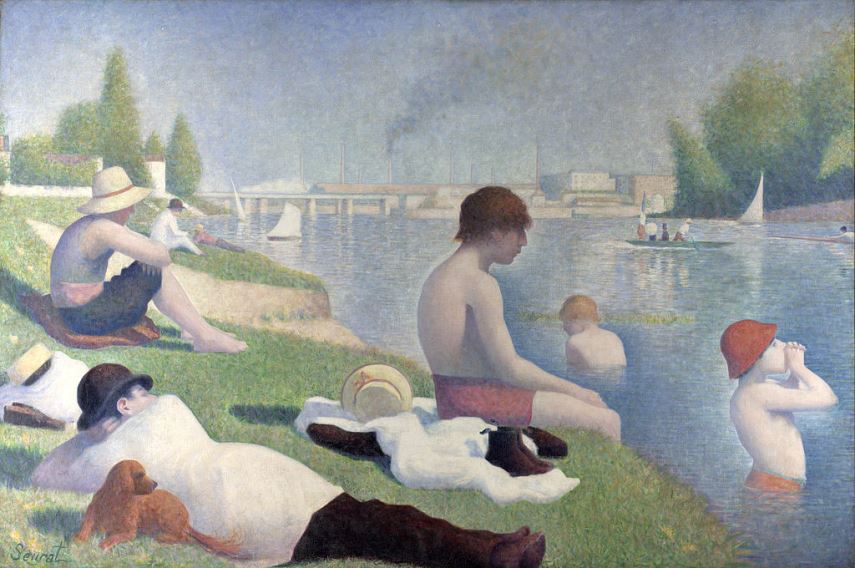
Thinking back to the age of Renaissance, the golden ratio or golden rectangle was one of the commencement compositional tools that exemplified the search for order. This search reflected the adoration for nature and divine. Various painters, such as Leonardo da Vinci, Salvador Dali, or Georges Seurat implemented the idea of the gilt ratio. Today, nosotros are provided with a grid which in fact helps us to recognize the placement of the artwork parts following such an one-time thought. The idea of the grid today various graphic designers utilise to aid arrange different elements in affiche or web page pattern[2].
Come across more works past Salvador Dali on our marketplace!
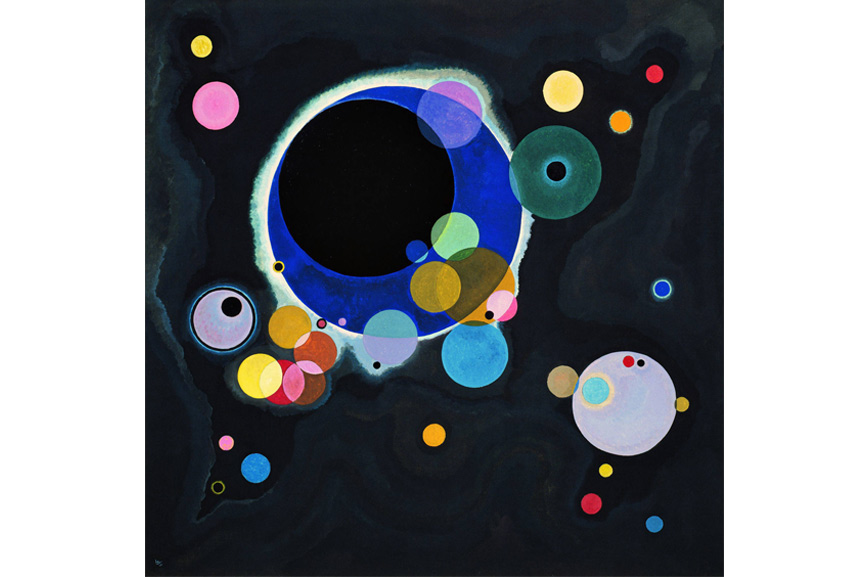
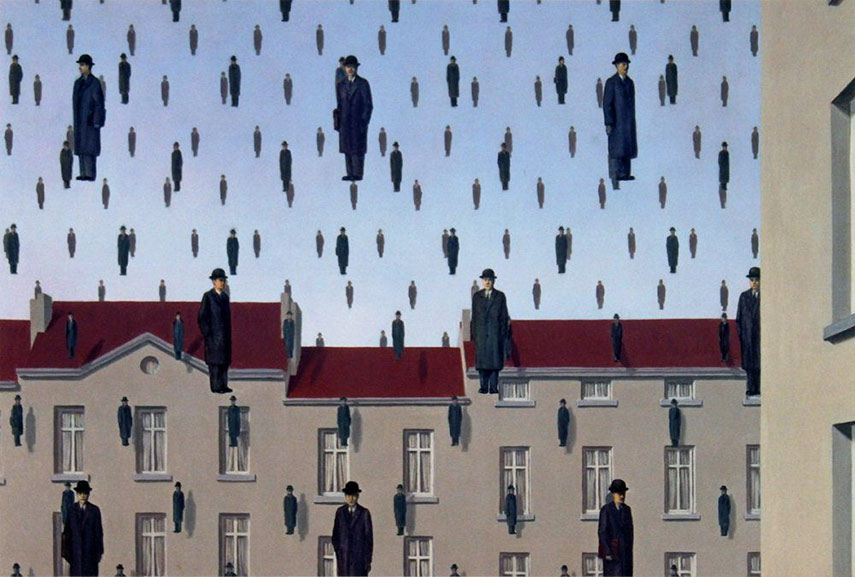
Looking back at the birth of abstract art, famous artist Wassily Kandinsky was a pioneer in the development of abstract, nonrepresentational pieces. Assertive in the expressive quality of abstract forms, line, and color, he oftentimes used repetition to aid build his paintings. In his painting Several Circles, harmony is achieved past the repetition of the circle on the neutral background. Variety is also achieved past the various sizes and colors of the geometrical object. In his surreal painting Golconda, Rene Magritte as well relied on repetition merely also focused on the restriction of the colour palette. Using grey tones and pastels, along with the repeated use of windows and men, a blueprint was created across the entire painting. Relief from such constant motif is provided in the patently gray edifice placed on the correct. Various artists, such as above mentioned Georges Seurat, Jasper Johns, or Cesar Santos played with texture and brushstrokes to achieve order and variety of the rhythm in their paintings.
The Sense of Order in Contemporary Fine art Production
The spirit of postmodernism, influenced by the demand to suspension strict definitions drives creative authors to question issues never questioned in the past. The strict border between various disciplines is gone yet what remains are the fine art elements and its principle. Followed by the demand for order, diverse artists play with the idea of the chaos. Looking at Tracey Emin's piece of work My Bed we recognize that the refusal to follow rules became the rule itself. All the various found objects worked together to help form a unity in the context of the piece and this, of course, is still another quality of unity in fine art. What may appear as a misbalanced composition, in fact, may hibernate an allegory of various philosophical or social bug, and in such works one needs to view each object every bit a symbol.
Click here to run across bachelor works by Tracey Emin!
From a practical signal of view, the search for a harmonious solution influences the placement and order of lines, texture, sizes, shapes, or colors within the work. To attain the sense of society, which helps transmit the work'southward message or the desired atmosphere is why unity in art is a crucial and important principle. If a certain chemical element broke away from the underlined compositional route, a produced painting or a sculpture would seem slightly off. In the end, the piece of work needs to communicate and without a certain gild, the bulletin of the slice would not attain its public.


The principle of unity is perhaps the nearly important of the design principles, still it is often the most difficult one to understand. To understand this circuitous notion, the author of the book takes u.s.a. to the beginning and presents the foundations of art and design. Exploring in various capacity the micro to macro topics, circuitous artworks and their inner systems standing at its core are brought closer to the readers. Looking at color, line, texture, proportion, and motility, the author explores how various ideas and concepts are built.
References:
-
- Collingwood, R., G., The Principles of Art, Read Books, 2011
- Zakia, R., D., Page, D., Photographic Composition: A Visual Guide, Elsevier Inc., 2011
All images used for illustrative purpose only. Featured image in slider: Wassily Kandinsky - Abstract Composition. Prototype via widewalls.ch; Yayoi Kusama - Kusama with Pumpkin. Image via anothermag.com;Damien Hirst - Spot painting. Image via whatartdoes.wordpress.com
Source: https://www.widewalls.ch/magazine/unity-in-art
0 Response to "Def of Unity in Art Examples of Unity to Create Balance"
Postar um comentário