43 Distinguishing Between Atoms Section Review Answer Key
Chapter ii. Atoms, Molecules, and Ions
2.3 Atomic Structure and Symbolism
Learning Objectives
Past the end of this section, you volition be able to:
- Write and interpret symbols that draw the atomic number, mass number, and charge of an atom or ion
- Define the atomic mass unit and average diminutive mass
- Calculate average atomic mass and isotopic affluence
The evolution of modern diminutive theory revealed much most the inner structure of atoms. It was learned that an atom contains a very small nucleus composed of positively charged protons and uncharged neutrons, surrounded by a much larger volume of space containing negatively charged electrons. The nucleus contains the bulk of an atom's mass because protons and neutrons are much heavier than electrons, whereas electrons occupy almost all of an atom's book. The diameter of an atom is on the order of x−10 m, whereas the diameter of the nucleus is roughly 10−15 thou—about 100,000 times smaller. For a perspective nearly their relative sizes, consider this: If the nucleus were the size of a huckleberry, the cantlet would exist about the size of a football stadium (Figure i).
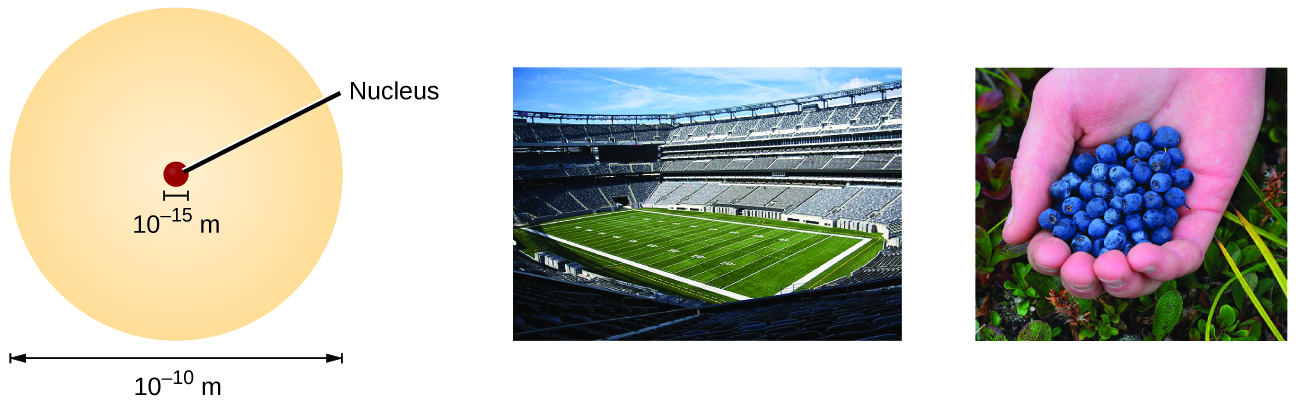
Atoms—and the protons, neutrons, and electrons that compose them—are extremely pocket-sized. For example, a carbon atom weighs less than 2 × 10⁻²³ g, and an electron has a charge of less than 2 × x−19 C (coulomb). When describing the properties of tiny objects such every bit atoms, we use appropriately small units of measure, such as the diminutive mass unit of measurement (amu) and the fundamental unit of measurement of accuse (e). The amu was originally defined based on hydrogen, the lightest chemical element, then later in terms of oxygen. Since 1961, it has been defined with regard to the near abundant isotope of carbon, atoms of which are assigned masses of exactly 12 amu. (This isotope is known every bit "carbon-12" as volition exist discussed later in this module.) Thus, i amu is exactly [latex]\frac{1}{12}[/latex] of the mass of one carbon-12 atom: 1 amu = i.6605 × ten−24 thousand. (The Dalton (Da) and the unified atomic mass unit (u) are alternative units that are equivalent to the amu.) The fundamental unit of charge (likewise chosen the elementary charge) equals the magnitude of the charge of an electron (due east) with east = 1.602 × 10⁻¹⁹ C.
A proton has a mass of 1.0073 amu and a charge of ane+. A neutron is a slightly heavier particle with a mass 1.0087 amu and a charge of zero; as its name suggests, information technology is neutral. The electron has a accuse of one− and is a much lighter particle with a mass of about 0.00055 amu (it would take well-nigh 1800 electrons to equal the mass of ane proton. The backdrop of these fundamental particles are summarized in Table 3. (An observant student might notice that the sum of an atom's subatomic particles does not equal the atom's actual mass: The total mass of six protons, six neutrons, and half dozen electrons is 12.0993 amu, slightly larger than 12.00 amu. This "missing" mass is known as the mass defect, and yous will acquire nigh it in the chapter on nuclear chemistry.)
| Name | Location | Charge (C) | Unit of measurement Charge | Mass (amu) | Mass (one thousand) |
|---|---|---|---|---|---|
| electron | exterior nucleus | −1.602 × x−xix | 1− | 0.00055 | 0.00091 × ten−24 |
| proton | nucleus | 1.602 × 10⁻¹⁹ | 1+ | 1.00727 | i.67262 × 10−24 |
| neutron | nucleus | 0 | 0 | one.00866 | one.67493 × 10−24 |
| Table 3. Properties of Subatomic Particles | |||||
The number of protons in the nucleus of an atom is its atomic number (Z). This is the defining trait of an element: Its value determines the identity of the atom. For case, any atom that contains six protons is the element carbon and has the diminutive number 6, regardless of how many neutrons or electrons it may accept. A neutral atom must incorporate the same number of positive and negative charges, so the number of protons equals the number of electrons. Therefore, the atomic number also indicates the number of electrons in an atom. The total number of protons and neutrons in an atom is called its mass number (A). The number of neutrons is therefore the departure between the mass number and the diminutive number: A – Z = number of neutrons.
[latex]\begin{array}{r @ {{}={}} l} \text{atomic number (Z)} & \text{number of protons} \\[1em] \text{mass number (A)} & \text{number of protons + number of neutrons} \\[1em] \text{A - Z} & \text{number of neutrons} \end{array}[/latex]
Atoms are electrically neutral if they incorporate the aforementioned number of positively charged protons and negatively charged electrons. When the numbers of these subatomic particles are non equal, the atom is electrically charged and is called an ion. The charge of an atom is defined every bit follows:
Atomic charge = number of protons − number of electrons
As will exist discussed in more item after in this chapter, atoms (and molecules) typically acquire charge by gaining or losing electrons. An atom that gains i or more electrons will exhibit a negative charge and is called an anion. Positively charged atoms chosen cations are formed when an atom loses one or more electrons. For example, a neutral sodium atom (Z = eleven) has 11 electrons. If this atom loses 1 electron, it will go a cation with a one+ accuse (11 − ten = one+). A neutral oxygen cantlet (Z = eight) has eight electrons, and if it gains two electrons it will become an anion with a 2− charge (viii − x = two−).
Example ane
Composition of an Atom
Iodine is an essential trace element in our nutrition; it is needed to produce thyroid hormone. Bereft iodine in the diet can lead to the development of a goiter, an enlargement of the thyroid gland (Figure ii).
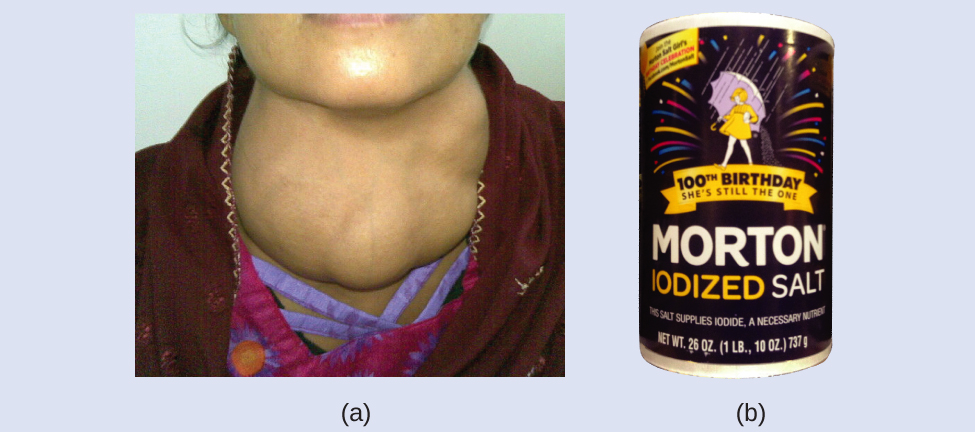
The improver of small amounts of iodine to table table salt (iodized salt) has substantially eliminated this health concern in the United States, but as much as 40% of the earth's population is nevertheless at risk of iodine deficiency. The iodine atoms are added as anions, and each has a ane− charge and a mass number of 127. Determine the numbers of protons, neutrons, and electrons in 1 of these iodine anions.
Solution
The atomic number of iodine (53) tells us that a neutral iodine atom contains 53 protons in its nucleus and 53 electrons outside its nucleus. Because the sum of the numbers of protons and neutrons equals the mass number, 127, the number of neutrons is 74 (127 − 53 = 74). Since the iodine is added every bit a 1− anion, the number of electrons is 54 [53 – (1–) = 54].
Check Your Learning
An ion of platinum has a mass number of 195 and contains 74 electrons. How many protons and neutrons does it contain, and what is its charge?
Answer:
78 protons; 117 neutrons; charge is four+
Chemical Symbols
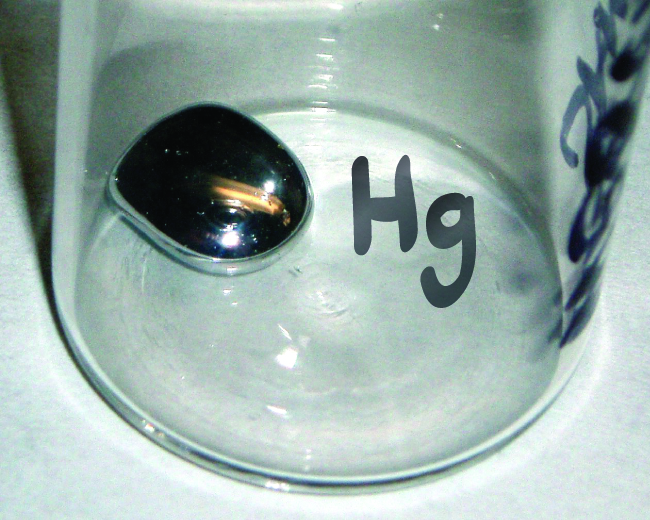
A chemical symbol is an abbreviation that we utilise to betoken an element or an atom of an element. For example, the symbol for mercury is Hg (Figure three). We use the same symbol to indicate one atom of mercury (microscopic domain) or to label a container of many atoms of the element mercury (macroscopic domain).
The symbols for several common elements and their atoms are listed in Table 4. Some symbols are derived from the common name of the element; others are abbreviations of the name in some other language. Most symbols have one or ii letters, simply three-letter of the alphabet symbols have been used to depict some elements that accept atomic numbers greater than 112. To avoid confusion with other notations, only the kickoff letter of a symbol is capitalized. For example, Co is the symbol for the element cobalt, only CO is the notation for the compound carbon monoxide, which contains atoms of the elements carbon (C) and oxygen (O). All known elements and their symbols are in the periodic tabular array in Figure 2 in Affiliate two.5 The Periodic Table (as well constitute in Appendix A).
| Element | Symbol | Element | Symbol |
|---|---|---|---|
| aluminum | Al | fe | Fe (from ferrum) |
| bromine | Br | atomic number 82 | Pb (from plumbum) |
| calcium | Ca | magnesium | Mg |
| carbon | C | mercury | Hg (from hydrargyrum) |
| chlorine | Cl | nitrogen | North |
| chromium | Cr | oxygen | O |
| cobalt | Co | potassium | Grand (from kalium) |
| copper | Cu (from cuprum) | silicon | Si |
| fluorine | F | silverish | Ag (from argentum) |
| gold | Au (from aurum) | sodium | Na (from natrium) |
| helium | He | sulfur | S |
| hydrogen | H | tin | Sn (from stannum) |
| iodine | I | zinc | Zn |
| Table 4. Some Common Elements and Their Symbols | |||
Traditionally, the discoverer (or discoverers) of a new element names the element. Yet, until the proper noun is recognized by the International Union of Pure and Applied Chemistry (IUPAC), the recommended name of the new element is based on the Latin give-and-take(south) for its atomic number. For example, chemical element 106 was called unnilhexium (Unh), element 107 was called unnilseptium (Uns), and element 108 was called unniloctium (Uno) for several years. These elements are now named after scientists (or occasionally locations); for instance, chemical element 106 is now known as seaborgium (Sg) in honour of Glenn Seaborg, a Nobel Prize winner who was agile in the discovery of several heavy elements.

Visit this site to learn more about IUPAC, the International Union of Pure and Applied Chemistry, and explore its periodic table.
Isotopes
The symbol for a specific isotope of any chemical element is written by placing the mass number as a superscript to the left of the element symbol (Figure four). The atomic number is sometimes written as a subscript preceding the symbol, merely since this number defines the element's identity, as does its symbol, it is often omitted. For example, magnesium exists as a mixture of iii isotopes, each with an atomic number of 12 and with mass numbers of 24, 25, and 26, respectively. These isotopes can be identified as 24Mg, 25Mg, and 26Mg. These isotope symbols are read as "element, mass number" and tin be symbolized consistent with this reading. For example, 24Mg is read as "magnesium 24," and can be written as "magnesium-24" or "Mg-24." 25Mg is read as "magnesium 25," and can be written as "magnesium-25" or "Mg-25." All magnesium atoms accept 12 protons in their nucleus. They differ only because a 24Mg atom has 12 neutrons in its nucleus, a 25Mg atom has thirteen neutrons, and a 26Mg has fourteen neutrons.
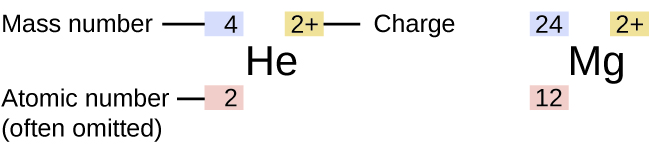
Information about the naturally occurring isotopes of elements with atomic numbers one through 10 is given in Table 5. Note that in addition to standard names and symbols, the isotopes of hydrogen are often referred to using common names and accompanying symbols. Hydrogen-2, symbolized 2H, is likewise chosen deuterium and sometimes symbolized D. Hydrogen-3, symbolized threeH, is besides called tritium and sometimes symbolized T.
| Element | Symbol | Atomic Number | Number of Protons | Number of Neutrons | Mass (amu) | % Natural Affluence |
|---|---|---|---|---|---|---|
| hydrogen | [latex]_1^1\text{H}[/latex] (protium) | 1 | 1 | 0 | 1.0078 | 99.989 |
| [latex]_1^2\text{H}[/latex] (deuterium) | one | 1 | ane | 2.0141 | 0.0115 | |
| [latex]_1^3\text{H}[/latex] (tritium) | 1 | 1 | 2 | 3.01605 | — (trace) | |
| helium | [latex]_2^3\text{He}[/latex] | ii | 2 | 1 | three.01603 | 0.00013 |
| [latex]_2^four\text{He}[/latex] | 2 | 2 | ii | iv.0026 | 100 | |
| lithium | [latex]_3^6\text{Li}[/latex] | 3 | iii | iii | 6.0151 | 7.59 |
| [latex]_3^7\text{Li}[/latex] | 3 | iii | four | seven.0160 | 92.41 | |
| beryllium | [latex]_4^9\text{Exist}[/latex] | 4 | 4 | five | nine.0122 | 100 |
| boron | [latex]_5^{10}\text{B}[/latex] | 5 | 5 | 5 | 10.0129 | 19.9 |
| [latex]_5^{11}\text{B}[/latex] | 5 | 5 | vi | 11.0093 | lxxx.ane | |
| carbon | [latex]_6^{12}\text{C}[/latex] | 6 | half-dozen | vi | 12.0000 | 98.89 |
| [latex]_6^{13}\text{C}[/latex] | 6 | 6 | 7 | xiii.0034 | ane.xi | |
| [latex]_6^{xiv}\text{C}[/latex] | 6 | half-dozen | viii | fourteen.0032 | — (trace) | |
| nitrogen | [latex]_7^{14}\text{N}[/latex] | vii | 7 | 7 | 14.0031 | 99.63 |
| [latex]_7^{xv}\text{N}[/latex] | 7 | 7 | viii | 15.0001 | 0.37 | |
| oxygen | [latex]_8^{16}\text{O}[/latex] | 8 | 8 | 8 | 15.9949 | 99.757 |
| [latex]_8^{17}\text{O}[/latex] | 8 | 8 | ix | 16.9991 | 0.038 | |
| [latex]_8^{18}\text{O}[/latex] | 8 | 8 | 10 | 17.9992 | 0.205 | |
| fluorine | [latex]_9^{19}\text{F}[/latex] | 9 | 9 | ten | 18.9984 | 100 |
| neon | [latex]_{10}^{twenty}\text{Ne}[/latex] | x | 10 | ten | 19.9924 | 90.48 |
| [latex]_{x}^{21}\text{Ne}[/latex] | 10 | x | xi | 20.9938 | 0.27 | |
| [latex]_{10}^{22}\text{Ne}[/latex] | 10 | 10 | 12 | 21.9914 | 9.25 | |
| Tabular array 5.Nuclear Compositions of Atoms of the Very Light Elements | ||||||
Use this Build an Atom simulator to build atoms of the first 10 elements, come across which isotopes exist, check nuclear stability, and proceeds experience with isotope symbols.
Diminutive Mass
Because each proton and each neutron contribute approximately one amu to the mass of an atom, and each electron contributes far less, the diminutive mass of a single atom is approximately equal to its mass number (a whole number). However, the boilerplate masses of atoms of almost elements are not whole numbers because most elements be naturally as mixtures of two or more than isotopes.
The mass of an element shown in a periodic table or listed in a table of atomic masses is a weighted, average mass of all the isotopes present in a naturally occurring sample of that element. This is equal to the sum of each individual isotope's mass multiplied by its partial abundance.
[latex]\displaystyle{} \text{boilerplate mass} = \sum_{i} (\text{partial abundance} \times \text{isotopic mass})_{i}[/latex]
For example, the element boron is composed of two isotopes: About nineteen.9% of all boron atoms are 10B with a mass of 10.0129 amu, and the remaining 80.1% are elevenB with a mass of 11.0093 amu. The average atomic mass for boron is calculated to exist:
[latex]\begin{array}{r @{{}={}} 50} \text{boron average mass} & (0.199 \times x.0129 \;\text{amu}) + (0.801 \times xi.0093 \;\text{amu}) \\[1em] & 1.99 \;\text{amu} + 8.82 \;\text{amu} \\[1em] & 10.81 \;\text{amu} \end{array}[/latex]
Information technology is important to understand that no single boron atom weighs exactly 10.8 amu; 10.8 amu is the boilerplate mass of all boron atoms, and private boron atoms weigh either approximately 10 amu or 11 amu.
Example 2
Calculation of Boilerplate Atomic Mass
A meteorite institute in key Indiana contains traces of the element of group 0 neon picked up from the solar air current during the meteorite'south trip through the solar arrangement. Analysis of a sample of the gas showed that it consisted of 91.84% 20Ne (mass nineteen.9924 amu), 0.47% 21Ne (mass 20.9940 amu), and 7.69% 22Ne (mass 21.9914 amu). What is the average mass of the neon in the solar wind?
Solution
[latex]\begin{array}{r @{{}={}} l} \text{average mass} & (0.9184 \times 19.9924 \;\text{amu}) + (0.0047 \times 20.9940 \;\text{amu})+(0.0769 \times 21.9914 \;\text{amu}) \\[1em] & (18.36+0.099+1.69) \;\text{amu} \\[1em] & 20.15 \;\text{amu} \end{array}[/latex]
The boilerplate mass of a neon atom in the solar current of air is 20.15 amu. (The average mass of a terrestrial neon cantlet is xx.1796 amu. This event demonstrates that we may find slight differences in the natural affluence of isotopes, depending on their origin.)
Bank check Your Learning
A sample of magnesium is found to contain 78.seventy% of 24Mg atoms (mass 23.98 amu), x.13% of 25Mg atoms (mass 24.99 amu), and 11.17% of 26Mg atoms (mass 25.98 amu). Summate the boilerplate mass of a Mg atom.
We tin can also do variations of this blazon of calculation, as shown in the next example.
Example 3
Calculation of Percent Abundance
Naturally occurring chlorine consists of 35Cl (mass 34.96885 amu) and 37Cl (mass 36.96590 amu), with an average mass of 35.453 amu. What is the percent limerick of Cl in terms of these 2 isotopes?
Solution
The average mass of chlorine is the fraction that is 35Cl times the mass of 35Cl plus the fraction that is 37Cl times the mass of 37Cl.
[latex]\text{average mass} = (\text{fraction of} \ ^{35}\text{Cl} \ \times \ \text{mass of} \ ^{35}\text{Cl}) + (\text{fraction of} \ ^{37}\text{Cl} \ \times \ \text{mass of} \ ^{37}\text{Cl})[/latex]
If we let x correspond the fraction that is 35Cl, then the fraction that is 37Cl is represented by 1.00 − ten.
(The fraction that is 35Cl + the fraction that is 37Cl must add together up to 1, so the fraction of 37Cl must equal ane.00 − the fraction of 35Cl.)
Substituting this into the average mass equation, we accept:
[latex]\brainstorm{array}{r @{{}={}} fifty}35.453 \;\text{amu} & (ten \times 34.96885 \;\text{amu}) + [(1.00 - x) \times 36.96590\;\text{amu}] \\[1em] 35.453 & 34.96885x + 36.96590 - 36.96590x \\[1em] i.99705x & ane.513 \\[1em] x & \frac{1.513}{ane.99705} = 0.7576 \finish{array}[/latex]
So solving yields: x = 0.7576, which ways that ane.00 − 0.7576 = 0.2424. Therefore, chlorine consists of 75.76% 35Cl and 24.24% 37Cl.
Check Your Learning
Naturally occurring copper consists of 63Cu (mass 62.9296 amu) and 65Cu (mass 64.9278 amu), with an average mass of 63.546 amu. What is the pct composition of Cu in terms of these two isotopes?
Reply:
69.xv% Cu-63 and 30.85% Cu-65
Visit this site to make mixtures of the master isotopes of the get-go 18 elements, gain experience with average atomic mass, and cheque naturally occurring isotope ratios using the Isotopes and Atomic Mass simulation.
The occurrence and natural abundances of isotopes tin be experimentally adamant using an instrument called a mass spectrometer. Mass spectrometry (MS) is widely used in chemistry, forensics, medicine, environmental science, and many other fields to analyze and help identify the substances in a sample of material. In a typical mass spectrometer (Effigy 5), the sample is vaporized and exposed to a high-energy electron beam that causes the sample's atoms (or molecules) to get electrically charged, typically by losing one or more than electrons. These cations and then pass through a (variable) electric or magnetic field that deflects each cation's path to an extent that depends on both its mass and charge (similar to how the path of a big steel brawl bearing rolling past a magnet is deflected to a lesser extent that that of a small steel BB). The ions are detected, and a plot of the relative number of ions generated versus their mass-to-charge ratios (a mass spectrum) is fabricated. The height of each vertical feature or peak in a mass spectrum is proportional to the fraction of cations with the specified mass-to-charge ratio. Since its initial use during the development of modern diminutive theory, MS has evolved to go a powerful tool for chemic analysis in a wide range of applications.
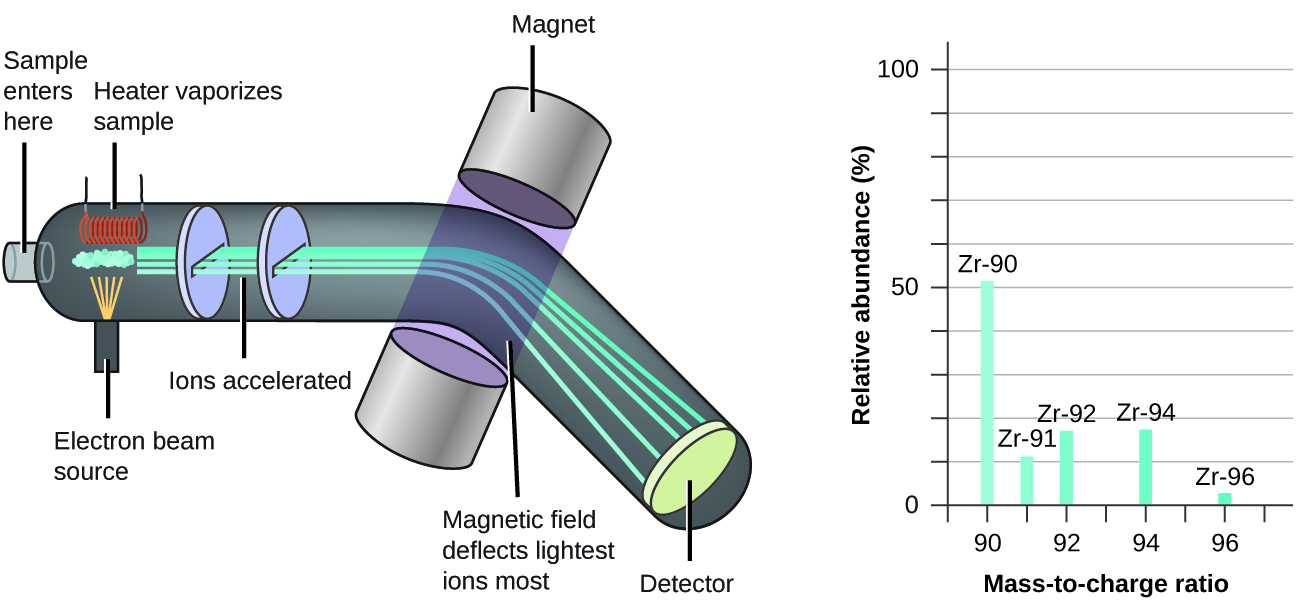
Encounter an animation that explains mass spectrometry. Sentry this video from the Royal Society for Chemistry for a brief description of the rudiments of mass spectrometry.
Key Concepts and Summary
An cantlet consists of a small, positively charged nucleus surrounded by electrons. The nucleus contains protons and neutrons; its bore is about 100,000 times smaller than that of the atom. The mass of one atom is ordinarily expressed in atomic mass units (amu), which is referred to as the atomic mass. An amu is defined as exactly [latex]\frac{1}{12}[/latex] of the mass of a carbon-12 atom and is equal to ane.6605 × x−24 m.
Protons are relatively heavy particles with a charge of i+ and a mass of ane.0073 amu. Neutrons are relatively heavy particles with no charge and a mass of 1.0087 amu. Electrons are low-cal particles with a charge of one− and a mass of 0.00055 amu. The number of protons in the nucleus is called the atomic number (Z) and is the holding that defines an atom's elemental identity. The sum of the numbers of protons and neutrons in the nucleus is called the mass number and, expressed in amu, is approximately equal to the mass of the atom. An atom is neutral when it contains equal numbers of electrons and protons.
Isotopes of an element are atoms with the same diminutive number but dissimilar mass numbers; isotopes of an element, therefore, differ from each other only in the number of neutrons within the nucleus. When a naturally occurring chemical element is composed of several isotopes, the atomic mass of the element represents the boilerplate of the masses of the isotopes involved. A chemical symbol identifies the atoms in a substance using symbols, which are one-, ii-, or 3-alphabetic character abbreviations for the atoms.
Central Equations
- [latex]\displaystyle{} \text{boilerplate mass} = \sum_{i} (\text{fractional affluence} \times \text{isotopic mass})_i[/latex]
Chemistry End of Chapter Exercises
- In what manner are isotopes of a given chemical element always different? In what fashion(s) are they always the same?
- Write the symbol for each of the following ions:
(a) the ion with a 1+ accuse, atomic number 55, and mass number 133
(b) the ion with 54 electrons, 53 protons, and 74 neutrons
(c) the ion with atomic number 15, mass number 31, and a 3− charge
(d) the ion with 24 electrons, 30 neutrons, and a three+ charge
- Write the symbol for each of the post-obit ions:
(a) the ion with a three+ accuse, 28 electrons, and a mass number of 71
(b) the ion with 36 electrons, 35 protons, and 45 neutrons
(c) the ion with 86 electrons, 142 neutrons, and a four+ charge
(d) the ion with a 2+ accuse, atomic number 38, and mass number 87
- Open the Build an Atom simulation and click on the Atom icon.
(a) Pick any ane of the outset 10 elements that you would like to build and state its symbol.
(b) Drag protons, neutrons, and electrons onto the atom template to make an cantlet of your element.
State the numbers of protons, neutrons, and electrons in your cantlet, equally well as the net accuse and mass number.
(c) Click on "Net Accuse" and "Mass Number," check your answers to (b), and correct, if needed.
(d) Predict whether your atom will be stable or unstable. Land your reasoning.
(e) Bank check the "Stable/Unstable" box. Was your respond to (d) correct? If non, first predict what yous can do to make a stable atom of your element, and then do it and meet if it works. Explain your reasoning.
- Open the Build an Cantlet simulation
(a) Drag protons, neutrons, and electrons onto the atom template to make a neutral atom of Oxygen-16 and give the isotope symbol for this atom.
(b) Now add two more electrons to make an ion and give the symbol for the ion you lot have created.
- Open the Build an Atom simulation
(a) Drag protons, neutrons, and electrons onto the atom template to brand a neutral atom of Lithium-6 and requite the isotope symbol for this atom.
(b) Now remove i electron to make an ion and give the symbol for the ion you have created.
- Make up one's mind the number of protons, neutrons, and electrons in the post-obit isotopes that are used in medical diagnoses:
(a) atomic number ix, mass number 18, charge of i−
(b) diminutive number 43, mass number 99, accuse of 7+
(c) atomic number 53, diminutive mass number 131, accuse of 1−
(d) diminutive number 81, atomic mass number 201, charge of 1+
(e) Name the elements in parts (a), (b), (c), and (d).
- The post-obit are properties of isotopes of two elements that are essential in our diet. Determine the number of protons, neutrons and electrons in each and name them.
(a) atomic number 26, mass number 58, charge of 2+
(b) atomic number 53, mass number 127, charge of one−
- Give the number of protons, electrons, and neutrons in neutral atoms of each of the following isotopes:
(a) [latex]_5^{x}\text{B}[/latex]
(b) [latex]_{80}^{199}\text{Hg}[/latex]
(c) [latex]_{29}^{63}\text{Cu}[/latex]
(d) [latex]_6^{13}\text{C}[/latex]
(e) [latex]_{34}^{77}\text{Se}[/latex]
- Give the number of protons, electrons, and neutrons in neutral atoms of each of the post-obit isotopes:
(a) [latex]_3^7\text{Li}[/latex]
(b) [latex]_{52}^{125}\text{Te}[/latex]
(c) [latex]_{47}^{109}\text{Ag}[/latex]
(d) [latex]_{7}^{fifteen}\text{N}[/latex]
(east) [latex]_{xv}^{31}\text{P}[/latex]
- Click on the site and select the "Mix Isotopes" tab, hibernate the "Percent Composition" and "Boilerplate Atomic Mass" boxes, and then select the element boron.
(a) Write the symbols of the isotopes of boron that are shown as naturally occurring in significant amounts.
(b) Predict the relative amounts (percentages) of these boron isotopes constitute in nature. Explain the reasoning behind your choice.
(c) Add isotopes to the black box to make a mixture that matches your prediction in (b). Yous may drag isotopes from their bins or click on "More" and so move the sliders to the appropriate amounts.
(d) Reveal the "Pct Composition" and "Average Diminutive Mass" boxes. How well does your mixture match with your prediction? If necessary, adjust the isotope amounts to lucifer your prediction.
(eastward) Select "Nature's" mix of isotopes and compare it to your prediction. How well does your prediction compare with the naturally occurring mixture? Explicate. If necessary, adjust your amounts to make them match "Nature'south" amounts as closely as possible.
- Repeat Chemical science End of Chapter Do 11 using an chemical element that has three naturally occurring isotopes.
- An element has the following natural abundances and isotopic masses: 90.92% affluence with 19.99 amu, 0.26% abundance with 20.99 amu, and eight.82% affluence with 21.99 amu. Calculate the average atomic mass of this element.
- Average atomic masses listed by IUPAC are based on a study of experimental results. Bromine has two isotopes 79Br and 81Br, whose masses (78.9183 and eighty.9163 amu) and abundances (50.69% and 49.31%) were determined in earlier experiments. Calculate the average atomic mass of bromine based on these experiments.
- Variations in average atomic mass may exist observed for elements obtained from different sources. Lithium provides an example of this. The isotopic composition of lithium from naturally occurring minerals is seven.5% 6Li and 92.five% 7Li, which have masses of half-dozen.01512 amu and 7.01600 amu, respectively. A commercial source of lithium, recycled from a armed forces source, was three.75% 6Li (and the rest 7Li). Calculate the average atomic mass values for each of these two sources.
- The average atomic masses of some elements may vary, depending upon the sources of their ores. Naturally occurring boron consists of two isotopes with accurately known masses (10B, 10.0129 amu and 11B, xi.0931 amu). The actual atomic mass of boron tin can vary from x.807 to 10.819, depending on whether the mineral source is from Turkey or the United States. Calculate the percentage abundances leading to the two values of the boilerplate atomic masses of boron from these ii countries.
- The xviiiO:16O abundance ratio in some meteorites is greater than that used to calculate the boilerplate atomic mass of oxygen on earth. Is the average mass of an oxygen atom in these meteorites greater than, less than, or equal to that of a terrestrial oxygen atom?
Glossary
- anion
- negatively charged atom or molecule (contains more than electrons than protons)
- atomic mass
- average mass of atoms of an chemical element, expressed in amu
- diminutive mass unit of measurement (amu)
- (too, unified atomic mass unit, u, or Dalton, Da) unit of mass equal to [latex]\frac{1}{12}[/latex] of the mass of a 12C atom
- atomic number (Z)
- number of protons in the nucleus of an atom
- cation
- positively charged atom or molecule (contains fewer electrons than protons)
- chemical symbol
- i-, ii-, or three-letter abbreviation used to stand for an element or its atoms
- Dalton (Da)
- alternative unit of measurement equivalent to the atomic mass unit
- fundamental unit of charge
- (also called the unproblematic charge) equals the magnitude of the charge of an electron (e) with east = 1.602 × 10−nineteen C
- ion
- electrically charged atom or molecule (contains unequal numbers of protons and electrons)
- mass number (A)
- sum of the numbers of neutrons and protons in the nucleus of an atom
- unified atomic mass unit of measurement (u)
- alternative unit of measurement equivalent to the atomic mass unit
Solutions
Answers to Chemical science Cease of Chapter Exercises
ii. (a) 133Cs+; (b) 127I−; (c) 31P3−; (d) 57Co3+
four. (a) Carbon-12, 12C; (b) This atom contains 6 protons and six neutrons. There are vi electrons in a neutral 12C atom. The net charge of such a neutral cantlet is aught, and the mass number is 12. (c) The preceding answers are right. (d) The atom will be stable since C-12 is a stable isotope of carbon. (e) The preceding answer is correct. Other answers for this practice are possible if a different element of isotope is chosen.
six. (a) Lithium-6 contains 3 protons, iii neutrons, and three electrons. The isotope symbol is viLi or [latex]_3^6\text{Li}[/latex]. (b) half dozenLi+ or [latex]_3^6 \text{Li}^+[/latex]
8. (a) Fe, 26 protons, 24 electrons, and 32 neutrons; (b) iodine, 53 protons, 54 electrons, and 74 neutrons
10. (a) iii protons, three electrons, 4 neutrons; (b) 52 protons, 52 electrons, 73 neutrons; (c) 47 protons, 47 electrons, 62 neutrons; (d) seven protons, 7 electrons, eight neutrons; (e) 15 protons, xv electrons, sixteen neutrons
12. Let united states of america use neon as an example. Since there are three isotopes, there is no way to be sure to accurately predict the abundances to brand the total of 20.18 amu average diminutive mass. Permit u.s.a. gauge that the abundances are 9% Ne-22, 91% Ne-twenty, and only a trace of Ne-21. The average mass would be 20.xviii amu. Checking the nature's mix of isotopes shows that the abundances are 90.48% Ne-20, 9.25% Ne-22, and 0.27% Ne-21, so our guessed amounts have to be slightly adapted.
14. 79.904 amu
16. Turkey source: 0.2649 (of 10.0129 amu isotope); US source: 0.2537 (of 10.0129 amu isotope)
Source: https://opentextbc.ca/chemistry/chapter/2-3-atomic-structure-and-symbolism/
0 Response to "43 Distinguishing Between Atoms Section Review Answer Key"
Postar um comentário